
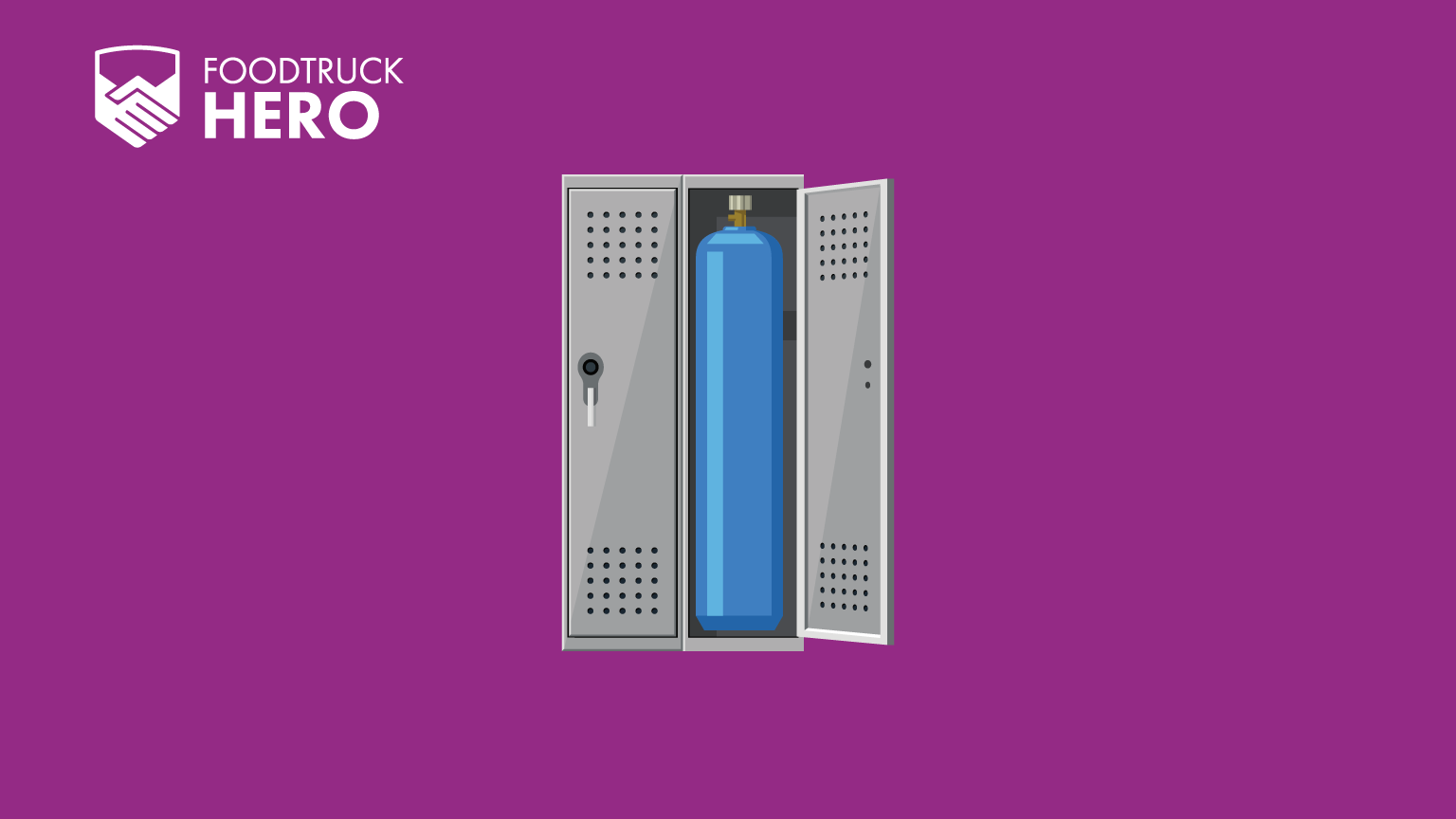
Storage and use of LPG cylinders
It should be noted that the safe handling of liquefied petroleum gas in catering stalls requires proper storage, adequate ventilation and training for staff. In addition, care must be taken to ensure that suitable fire-extinguishing agents are available to minimise the risk of fires and explosions.
The following measures must be observed to ensure proper storage:
When storing solid mixtures, liquids and gases, care must be taken to ensure adequate ventilation and that the location is protected from direct sunlight.
Liquefied gas cylinders and cartridges should, where possible, be stored outdoors in a lockable cage or liquefied gas cabinet made of non-combustible material. This must be secured against unauthorised access and labelled with the prescribed hazard symbols.
There must be no sources of ignition, heat or flammable substances in the vicinity, and the smoking ban must be observed.
Hazard zones relating to the installation of LPG cabinets must be assessed and defined by the organiser’s safety officer. Where necessary, zones must be defined and additional protective measures taken.
If liquefied petroleum gas is stored indoors, additional requirements apply. These should be specified by the organiser’s safety officer as required.
Due to the hazards posed by liquefied petroleum gas, the handling of LPG cylinders is restricted to trained personnel only. It is important to ensure that the valves on all gas cylinders are always securely closed, as the cylinders are never completely empty.
Each cylinder must be fitted with a protective cap and stored in an upright position, secured to prevent it from falling over.
Suitable fire-extinguishing equipment must be available at every catering stall, including a foam fire extinguisher with at least six extinguishing units and a grease fire extinguisher where deep-fat fryers are in use.
Staff must be trained in the use of fire extinguishers so that, in an emergency, they can react safely and quickly and tackle a fire at its onset.